The subject of resolution has been debated previously, and even commercial scanners manufacturers have conceded -by making higher resolution scanners- that there is more to 8mm film.
I have been exploring the topic and thought this visual comparison would be helpful when making a choice.
The setup
Raspberry Pi 4 HQ sensor with a Schneider-Kreuznach 50mm f2.4 set at f5.6, using an integrating sphere as light source. Using Tingopix sensel (raw sensor) capture software. The software allows for capturing each color channel with its own light intensity.
The film subject is a 1959 Kodachrome 8mm (Regular 8).
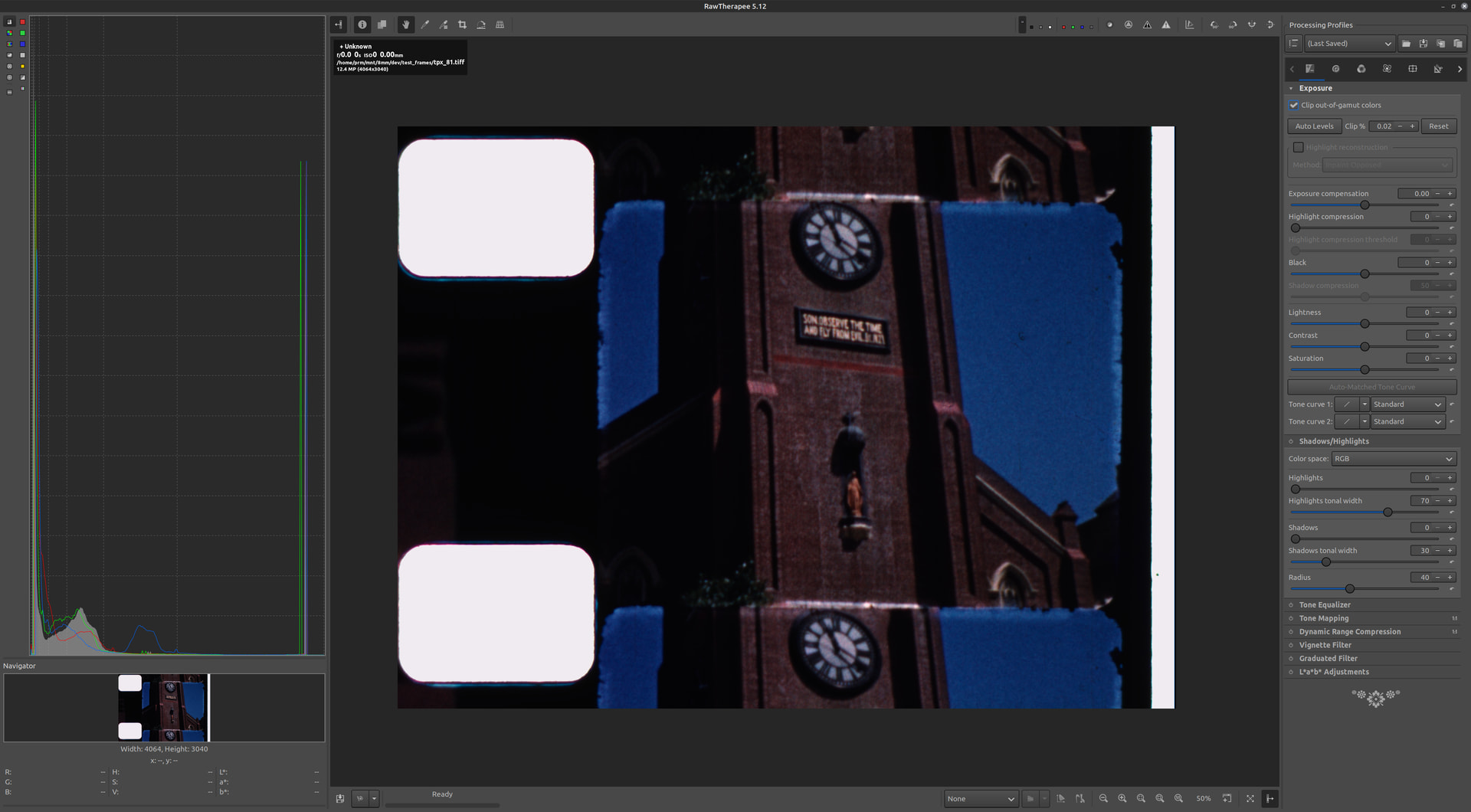
The same full-sensor raw-capture is saved either as vng debayered (full sensor resolution) or binned (half/vertical half/horizontal resolution = quarter spatial resolution). No sharpness applied. File format is TIFF 16bit uncompressed.
Content is viewed with Rawtherapee, which does not interpolate pixels for presentation.
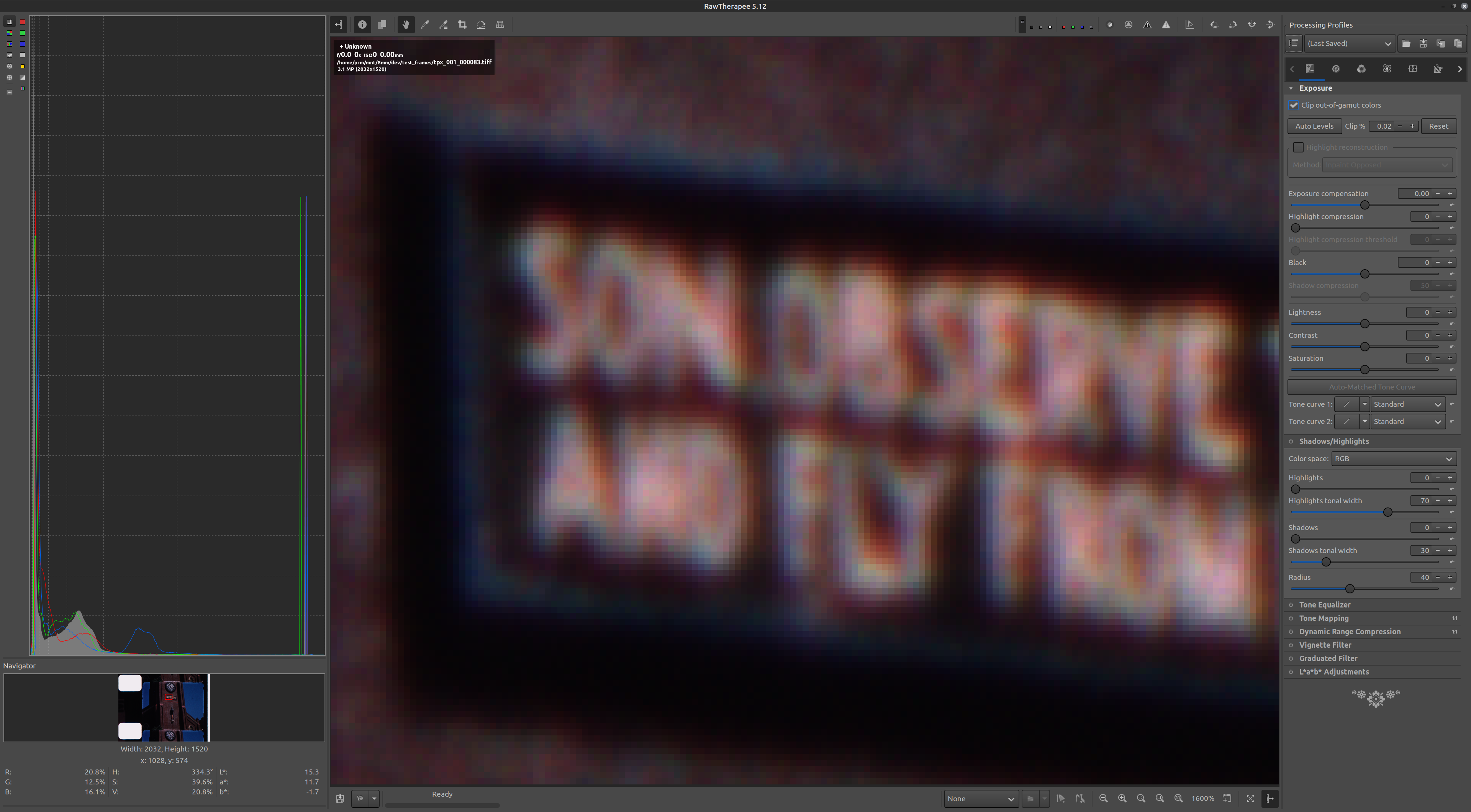
Single Capture per Channel (12 bit color depth)
True color pixels (binned) 12-bit resulting in quarter-sensor spatial resolution. (2032x1520@12bit)
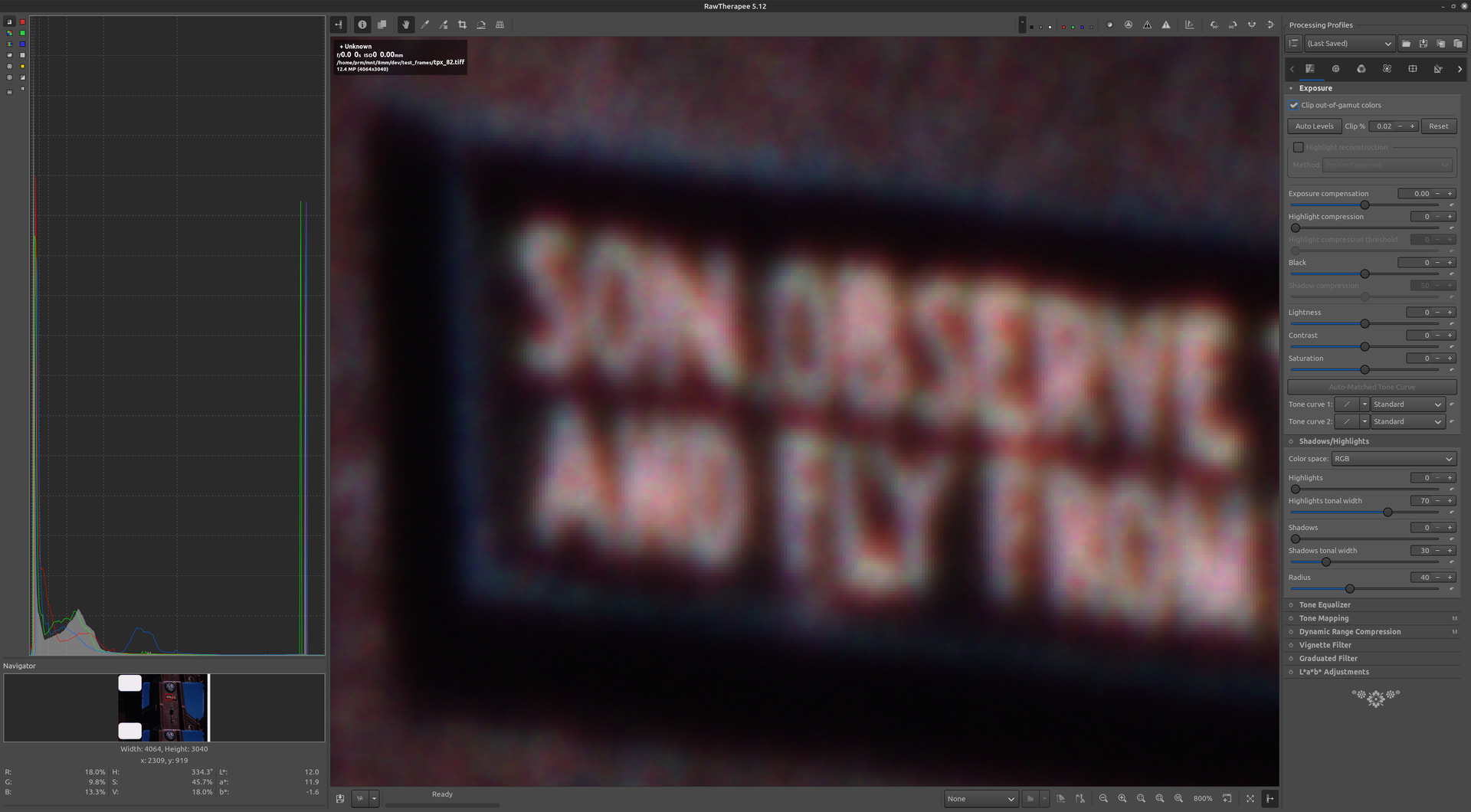
Compared to 12-bit full resolution vng debayering. (4064x3040@12bit)
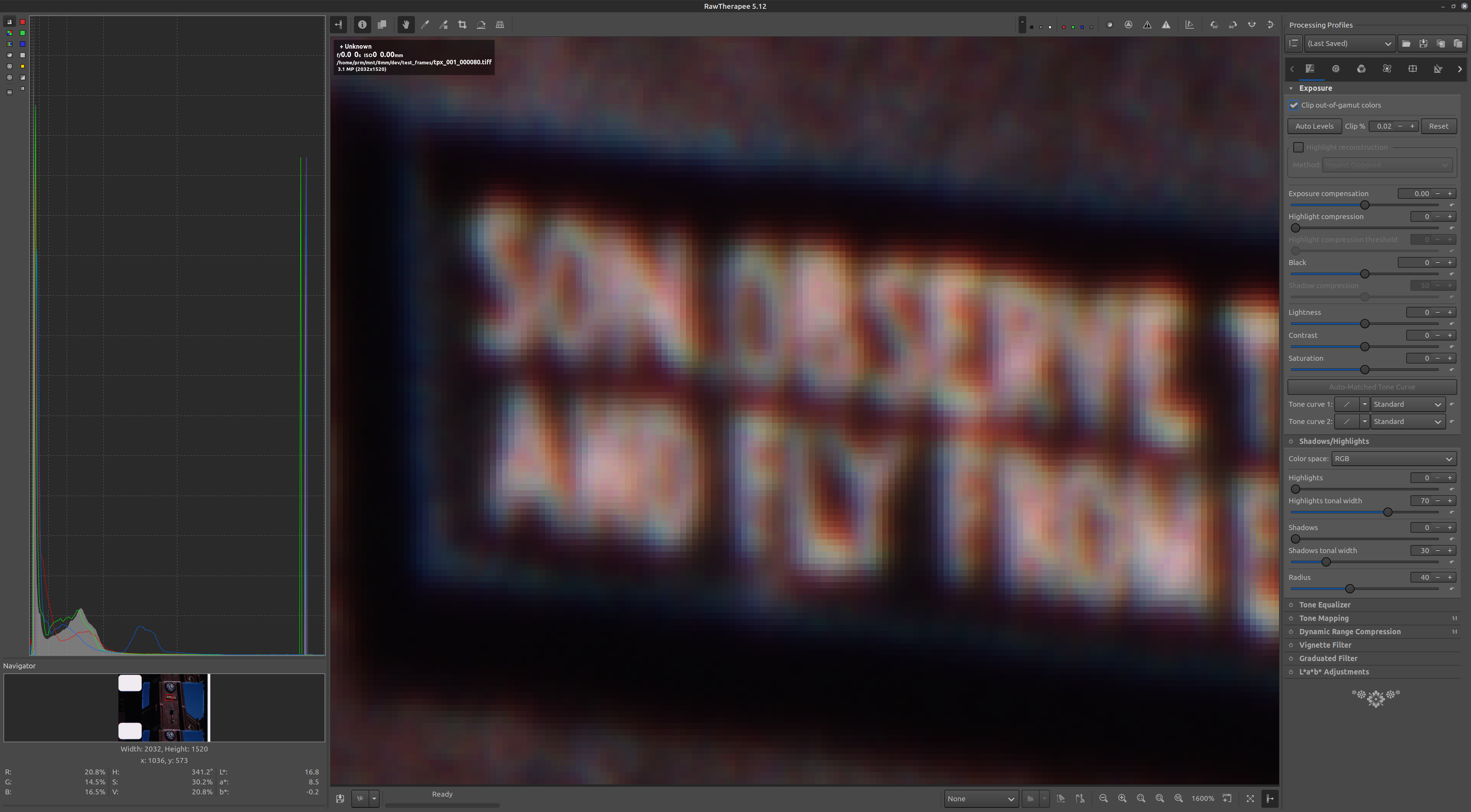
16 Captures per Channel (16 bit color depth)
True color pixels (binned) 16-bit resulting in quarter-sensor spatial resolution. (2032x1520@16bit)
Compared to 16-bit full resolution vng debayering. (4064x3040@16bit)
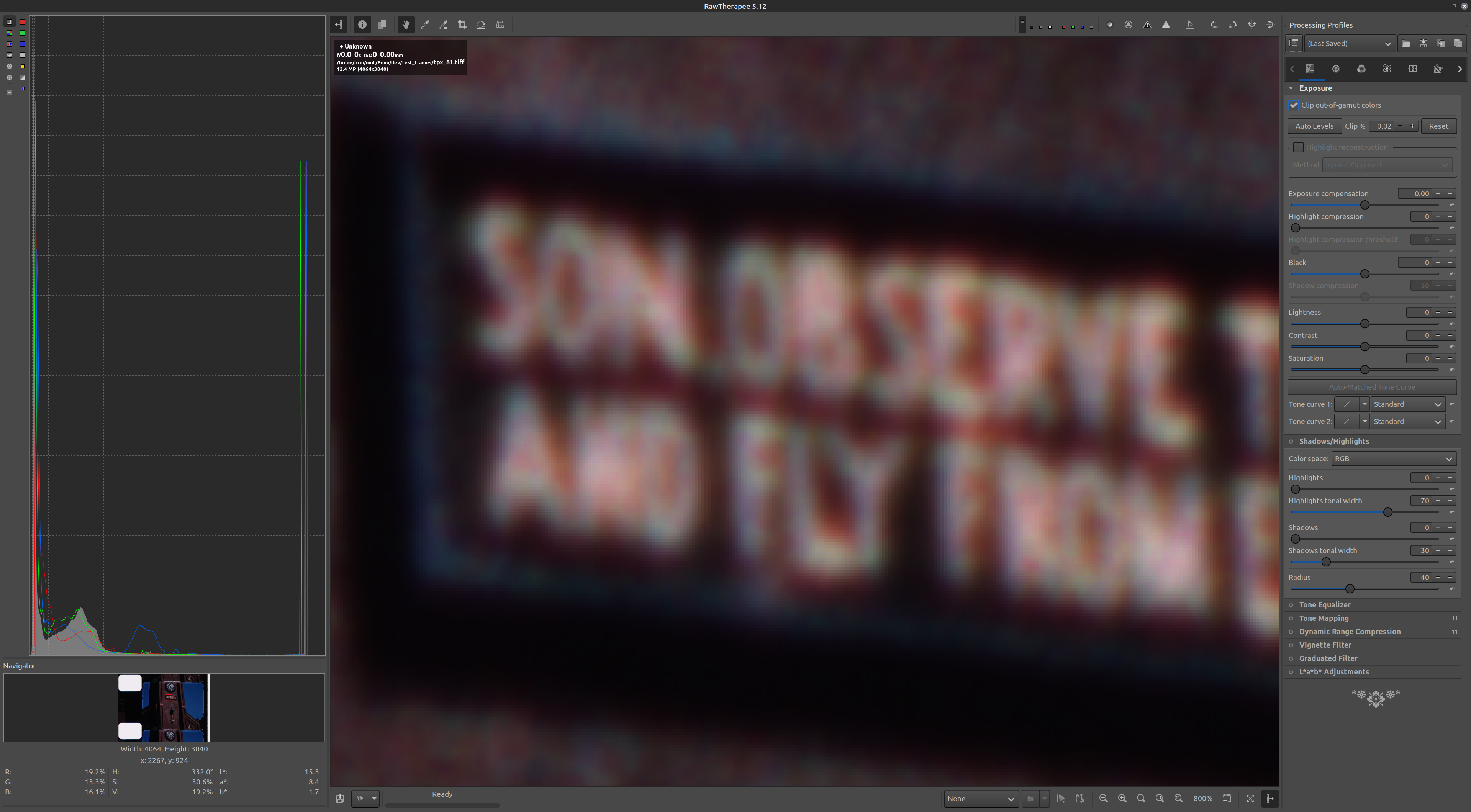
Summary
When capturing 16 times per channel, the noise is averaged resulting in smoother transitions (again no sharpness was applied). The higher noise in the one-capture creates the perception than the image is sharper, but in reality, is an illusion. The higher noise is less desirable for faded film that require higher color correction gains (not the case of the subject film).
Binning at quarter-size (2032x1520) provides a good compromise of size-speed particularly when the final output is 2K resolution. However, the example shows that even the standard-8 subject film has relevant content, showing that the full sensor vng debayering would be more suitable to preserve it with an output of 4K resolution. The vng debayering is computationally expensive and was performed post-capture.
It is appropriate to note than the VNG debayering method was chosen to minimize the color artifacts, so other debayering alternatives may increase color noise (debayering artifacts).
While not true for all subject-content, from the results it looks like more is more!
PS. the message did not go unnoticed: SON OBSERVE 