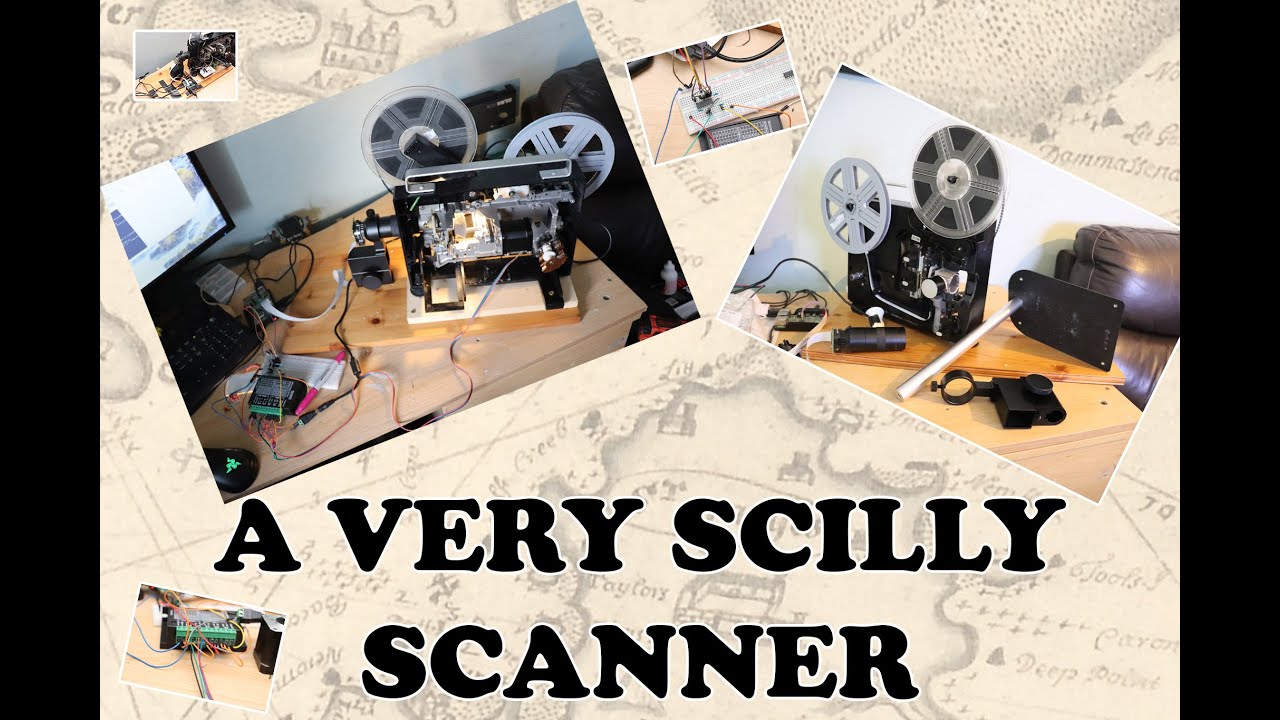
I am based in the UK and have been looking at the amazing DIY machines people have created to scan their cine film. They are beyond my ability to make from scratch, but I would love to upgrade my commercial £400 scanner without going to the next commercial step which seems to be a £10k-20k+ machine.
Is there forum, market place, web site where these DIY scanners are bought/sold?
Using an existing projector and setup a camera trigger to capture frame by frame. Usually via a reed switch, and slowing down the projector motor. A variation is to replace the motor with a stepper.
DIY projects that do not use projector parts. For example, Tscann-8 which has been done by a few builders.
On the second group, if you have access to a 3D printing shop and drilling (or laser cutting), you would not be starting from scratch.
The scanner that I built -in my opinion- is a bit simpler transport than Tscann-8, better results, and longer scanning time. One of my goals is to provide documentation as open-source for others to build it (similar to what Tscann has done). But until now have been using most -of the limited time I have- improving on it, mostly to get the scanning done at the quality that I was targeting (not the scanning speed). Mine is in the low-cost group, probably under $800 (with ebay lens).
There are some higher-speed higher-quality higher-cost (mostly the camera) projects here, such as Roland’s All format scanner.
In summary, the short answer is no marketplace, but the long answer is maybe some alternatives to look into.
That’s great info, many thanks for your reply. Your sub £1k build is in the ballpark for what I was looking for. I do own a laser cutter which might help with a build if I go that route.
From what i have read on forums the project to build your own scanner often seems to take many months and sometimes years. I understand that this is probably only working on it on and off, but I didn’t want the project to become building the scanner as opposed to scanning the films.
I will definitely have a look at the links you posted to see if there are any for sale, or if the build instructions seem comprehensive enough to give it a go.
Basically, a scanner consists of a film transport system, a lighting system, and a camera with its corresponding lens, all coordinated and controlled by appropriate software.
As @PM490 has rightly pointed out, I belong to the group that has built its own scanner using an old projector modified with a stepper motor for film transport. The reason is simple: although I have plenty of manual dexterity, I don’t have a workshop or the appropriate tools to build the scanner from scratch.
Using the projector makes things much easier, and you can have a good quality scanner in a short amount of time. Once you have all the components, it’s just a matter of a few days of work.
You can find several examples on this forum, including my own device.
As for the software, you can freely download my own DSuper8 software, which is free and open source, and is also published on this forum.
Here’s a link to a video of an enthusiast who built his projector-based scanner in just one day:
In reality is the design-test iteration that takes that long. If one is starting with a proven design (or even built parts) it would be a more reasonable timeline.
Frankly, I didn’t think there will be buyers for a DIY built. With a bit of rework on the PCBs to simplify, maybe an assemble-yourself kit?
A while ago, a young student with no prior experience in electronics or computing contacted me. She was initially looking for someone willing to build her a scanner.
Using the limited resources she had at home and following my instructions, she successfully completed the construction of her own scanner within a reasonable timeframe—a few months, including the waiting time for the various components.
What I mean by this is that, with a little willpower and dedication, anyone can build a good quality scanner, even with modest resources.
Building a DIY film scanner requires a series of choices.
Each choice has its advantages and disadvantages.
The first choice is the film transport, so you must choose between a modified projector or a standalone system like Kinograph.
The truly professional solution is certainly the standalone system; however, modifying a projector allows an amateur to quickly obtain very satisfactory results.
The second choice is the camera. You will then need to consider:
The camera’s hardware specifications: resolution, frames per second, dynamic range, etc.
The computer and operating system (Windows, Mac, Raspberry Pi) and the capture software available or to be developed for this camera.
You must also choose a lens suitable for this camera
For the camera, I see three possibilities:
A USB camera
A DSLR (Canon, Nikon, Panasonic)
A Raspberry Pi camera
Some time ago, I digitized all my films with satisfactory results using a modified projector, a Raspberry Pi HQ camera, and software similar to @Manuel_Angel
Since then, OS and software changes have rendered my application obsolete. The Python library for controlling the camera has changed, and controlling the stepper motor is more complicated.
I know that @Manuel_Angel adapted his application to this new environment; however, in my opinion:
The new picamera2 library, which depends on libcamera, still presents problems.
The question of the quality we can expect from the Raspberry Pi Camera HQ remains open (many posts on this topic).
I think using a DSLR is to be considered and could give better results than the Raspberry Pi Camera HQ ?
Just having a larger sensor will help, and certainly the DSLRs falls into that class.
One item that I would add to your summary is the choice of light source, and even the LED specifications. While often overlooked or oversimplified, it is a critical component of any scanner.
To add to my post above, here are my latest experiments:
I was given some 8mm reels to digitize and I wanted to get it done as quickly as possible by reusing the modified projector from my previous project.
For the motor:
I reused the motor control with a Raspberry Pi 4 and the excellent pigpio library (which no longer works with a Pi 5).
But it’s interesting to know that it can be controlled remotely from a PC or Mac; it’s as simple as: motor = pigpio.pi('192.168.1.23') with the IP address of the Raspberry Pi running the pigpio daemon.
For the camera:
I abandoned the Raspberry Pi camera; I find the new picamera2 library still a bit experimental.
For a change, I used a Canon EOS 90D (APS-C sensor) with my Schneider 50mm lens, which gives an extension tube of about 20cm! I used the Canon EDSK, quickly creating a small Python application.
It works, but this is the least satisfactory part and might need improvement, as the Canon SDK is a rather outdated Windows COM application.
For the DSLR:
Electronic shutter, of course.
A monstrous resolution of 6160x4640!
Automatic exposure and white balance.
Obviously, it’s not very fast: 1.5 seconds per frame!
I know that using automatic exposure and white balance is open to criticism, but you have to admit that the DSLR does a really good job, practically no correction needed afterwards !
Then I resumed my usual processing and encoding procedures :
Resize to a more reasonable resolution of 1440x1080
Joining frames to a video with ffmpeg
I tried the ffmpeg stabilization plugin, with very good results
Degraining with Avisynth (Temporal Degrain plugin)
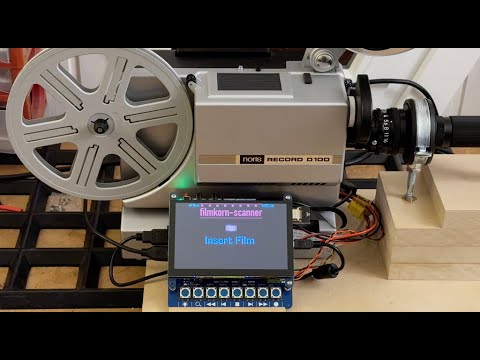
A good example of engineering that contains some interesting ideas, but in my opinion, a very complicated implementation for a project that should remain simple.
Creating an electronic board integrating all the components is complex and poorly suited to incremental modifications. The same applies to the motor control and the display, for which a PC application seems more flexible.
Obviously, we have a self-contained device that can be used directly, which can be interesting.