There is a lot in that question: let me break it down. Rollers
3MFs files for rollers (to import into slicer) are published already with drawings.
The Tscann does not hold tension, so the friction-capstan would not be simple. So I am guessing you plan to build a wider pinch-roller/capstan keeping the same Tscann design.
Light Source
The light source (integrating sphere) would not be too much work to publish the 3D components as it is currently.
For the final release, I was considering an update to have 4 ports and 4 LED PCBs (instead of the current 3). The reason was to reconfigure the White LEDs from 3-in-series, to 2-sets of 2-in-series. That changes the voltage required from the current 30V to 24V. That is not ready right now.
The light can setup at fix intensity with a current regulator (simple setup) or intensity be controlled by the DAC and Constant-Current Driver (2 PCBs). The DAC is fully controlled via I2C from the PICO. The alternatives:
– No DAC / always on controlled by current regulator (LM317). Need LED PCBs and setup the LM317.
– DAC and Driver but requires control via I2C.
Options for I2C controller:
– Incorporate I2C control on the Tscann Arduino. Note the DAC is 3.3V.
– Or use a PICO hardwiring to the DAC (subset of Tingopix controller). Light will be setup via USB serial command from the RPi.
In summary for the light source:
Right now (in a few days): 3 port LED 3D printing files, and legacy LED PCBs. (wiring a current regulator with an LM317 and two resistors).
We are needing a build a scanner ASAP, capable of Regular 8, Super 8 and 16mm. Is there a way to get the instructions or material list anywhere? @PM490
Hi @fabriccio, understand you need the scanner ASAP. Your profile says you own a lab, very cool! But please keep in mind that this is an opensource project, and nothing is guaranteed until is done. Ok?
One item that I like to confirm you read above is that this scanner has only been tested with smaller 16mm reels (90mm diameter). And without larger motors it may not handle the same diameter it can handle on 8mm.
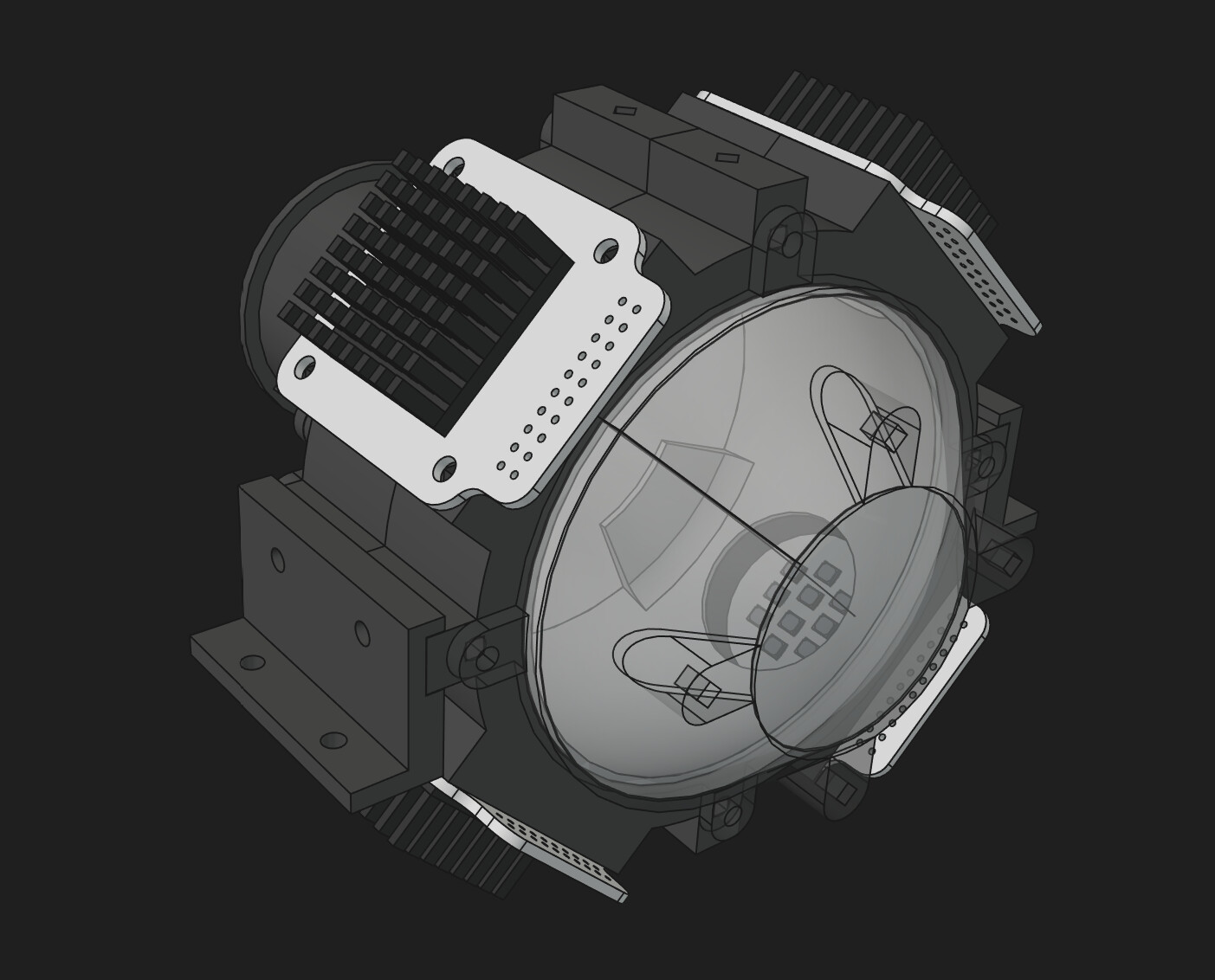
Status of the Sphere Files
Rather than expend time on working on the 3 port sphere, I decided to go ahead with the 4 port design. The size is very similar.
As shown in the picture, this is a path for multispectral illumination (+white). Clearly there is no need for so many white LEDs!
The new LED PCB draft shown holds 10 LEDs on the 2835 form-factor, the PCB is 40mm x 50mm.
In past postings I showed the DAC and Drivers, but after redesigning the LED PCBs, I will move some items around to make the 8 channels wiring less of a nightmare.
Expectations
I wish to complete the loose ends of the transport with white light, before embarking on writing the RPI for multispectral scanning. For Tingopix, it will take a few months before all the components are integrated to do 7 channel narrow-band multispectral scanning. But the hardware pieces of the puzzle are already posted. And part of the software is already there too, as it presently has the ability to scan each color channel separately with different light intensity (currently white light intensity).
Other postings on multispectral
@dswanson and @8mm are also experimenting with multispectral, and some of these new ideas or part may help their projects moving faster.
Sphere Test
@fabriccio I still need to route the PCB to complete the basic components of the sphere.
The 3D part design is complete, it is low risk since it is a second design round, but we don’t know until is print tested.
I have not printed the new sphere… if you wish to print it before I do, let me know and I will publish the STLs by the weekend… with no guarantees.
You are doing such a great job! Indeed and we saw you follow our lab on instagram: Arca Film Lab
I wanted to ask how long does it take to scan a full 50ft reel of super 8 (3600 frames approximately). And with that question in mind also how long for a 100ft 16mm reel.
@PM490 Is this project able to migrate to another hardware on the camera itself? To a better dynamic range or bigger sensor?
The fastest mode captures all color channels with one light setting. It provides 12bit dynamic range. For 3600 frames it will take ~2 hours and 45 minutes. For 16mm 100ft -estimating 4000 frames- it would take ~ 3 hours. On the same mode, with 16 captures for 16bit dynamic range it approximately doubles the capture time.
As mentioned, if one wishes the best of the best: 16 bit dynamic range, and full range for each color channel (separating light intensity)…
For 3600 frames ~ 10 hours. For 4000 frames ~ 11 hours and 15 minutes.
My idea of the high quality - long time modes is to scan a scene that requires maximum quality.
The times are measured with light DAC control (exposure is constant). The exposure change with the HQ slows down the capture.
It is also saving to a NAS storage with hd (ethernet 1gb port), it may be slightly faster saving to an SSD attached via USB3.
 thanks for sharing