… continuing my exploration of the RP5.
The RP5 features an upgraded ISP – which leads in turn to a new tuning file format. So there are currently two different directories where the tuning files are stored. One is /usr/share/libcamera/ipa/rpi/vc4, this is for the RP1-RP4 models. The other is /usr/share/libcamera/ipa/rpi/pisp, and this is for the new RP5 unit.
At least currently, the imx477_scientific.json is gone in the RP5 tuning file directory. The new tuning file format has a lot of new entries – some of them are connected to the new HDR possibilities, some others need to be checked. For example, the temporal denoise seem to be working in standard mode – something I would not like to happen in a film scanner setup.
Furthermore, there are indications that even the raw image you get in the standard configuration is not a true raw image. The RP5 ISP works normally with compressed (packed) raw. This is described as “visually lossless”. You can switch to unpacked formats which are described as “bit-exact”, but that’s not the default. I asked on the picamera2 discussion page for a clarification, but I bet that the raw the RP5 spits out in standard configuration is not really the raw sensor image.
Anyway. I manually edited something similar to the scientific tuning file to work with the RP5 ISP. The results I got are interesting. Here’s a capture with the HQ camera and the standard RP5 tuning file:
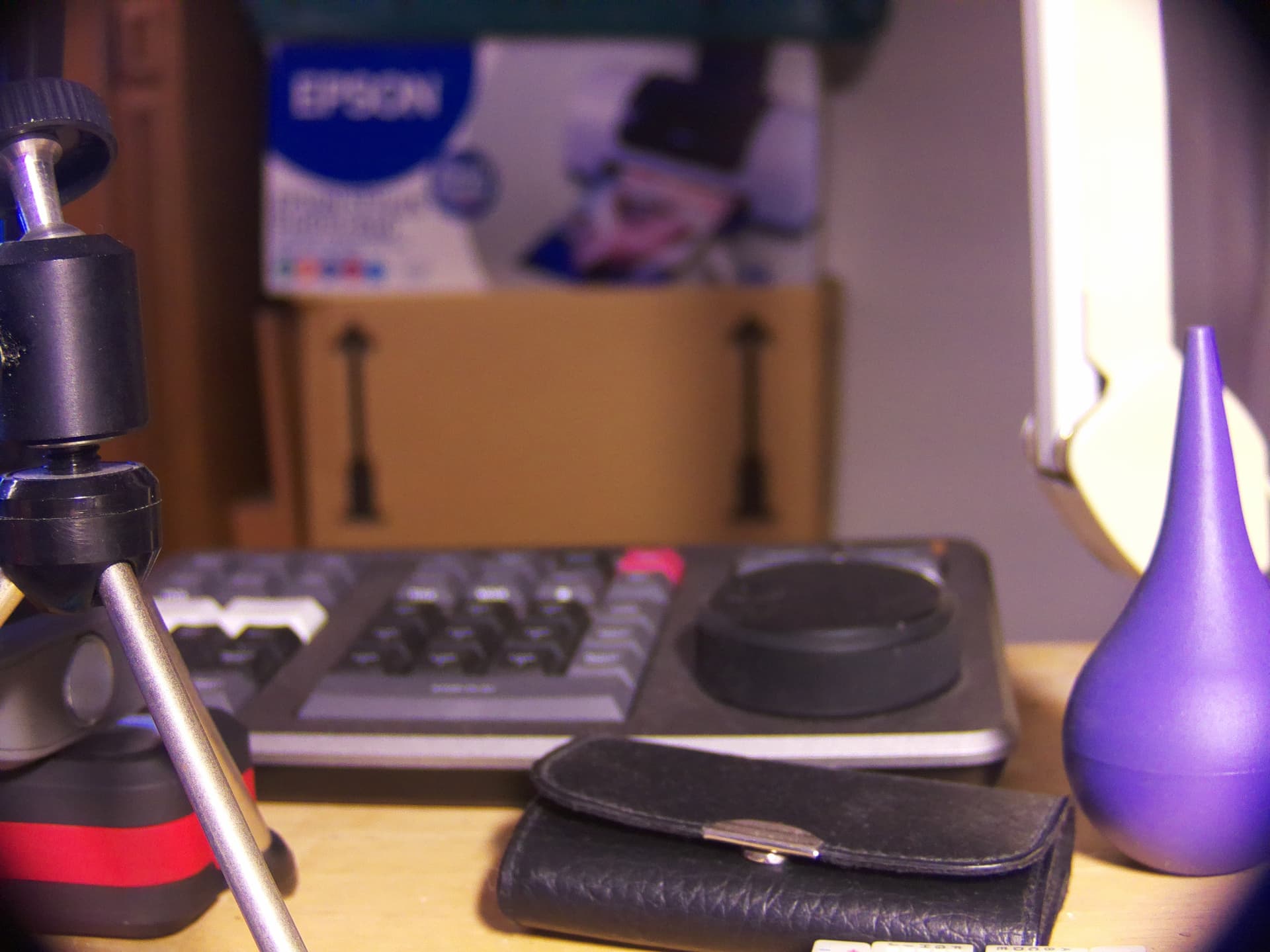
The air blower to the right of the image is in reality not purple. Neither does the daVinci speed editor in the background feature a purple touch - it’s basically a greyish plastic unit.
Here’s, for comparision, the same capture with my quick manual derivative of the scientific tuning file:
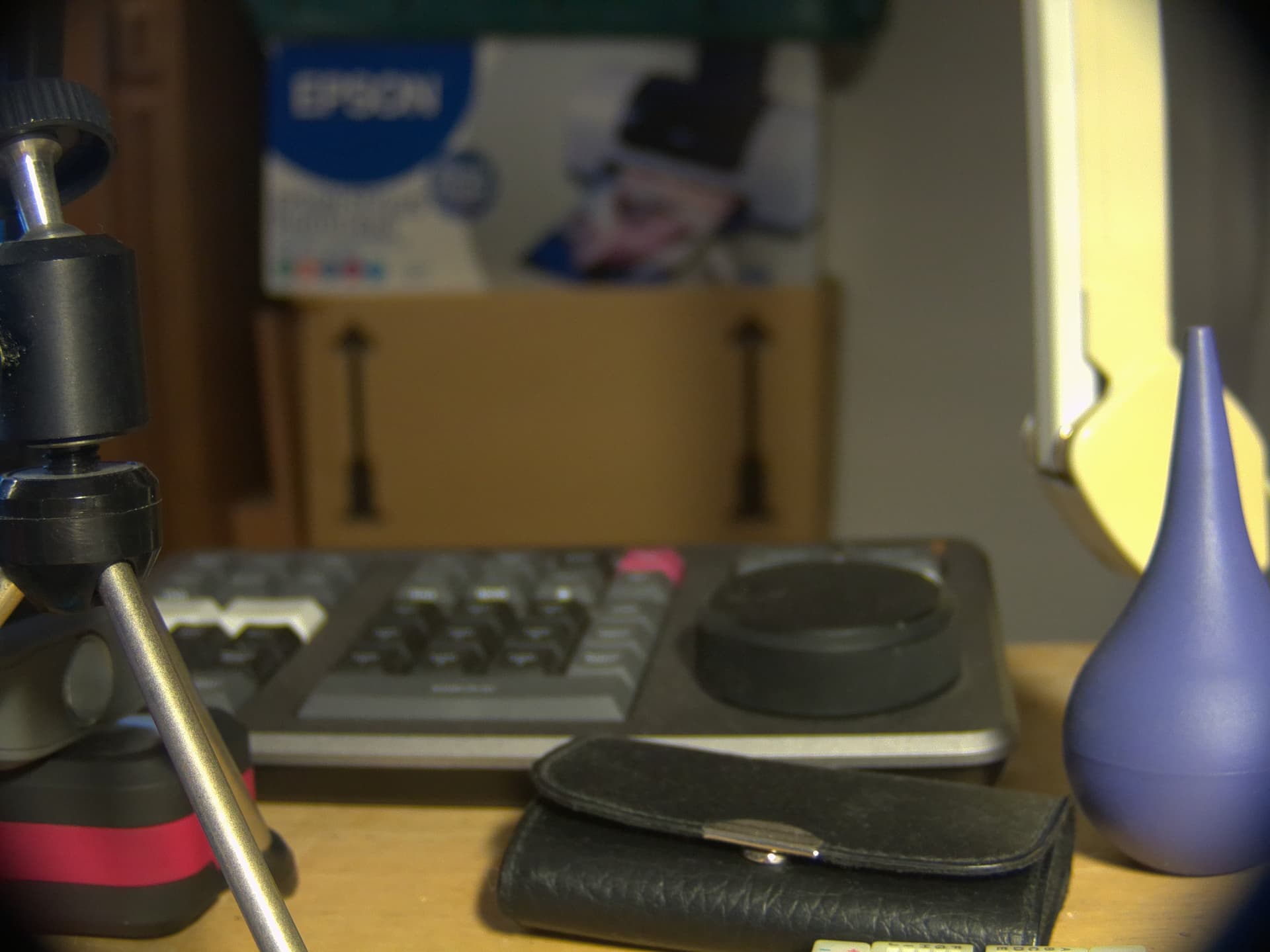
The air blower’s color is quite similar to the color my eyes see. A slight yellow-greenish cast can be noticed, but the colors are certainly less off than in the standard configuration.
Both captures were done with automatic exposure and white balancing. Illumination was with a desktop lamp only. Given, this is not a really good designed experiment, but I would have expected a better performance with the imx477 standard tuning file on the RP5.